
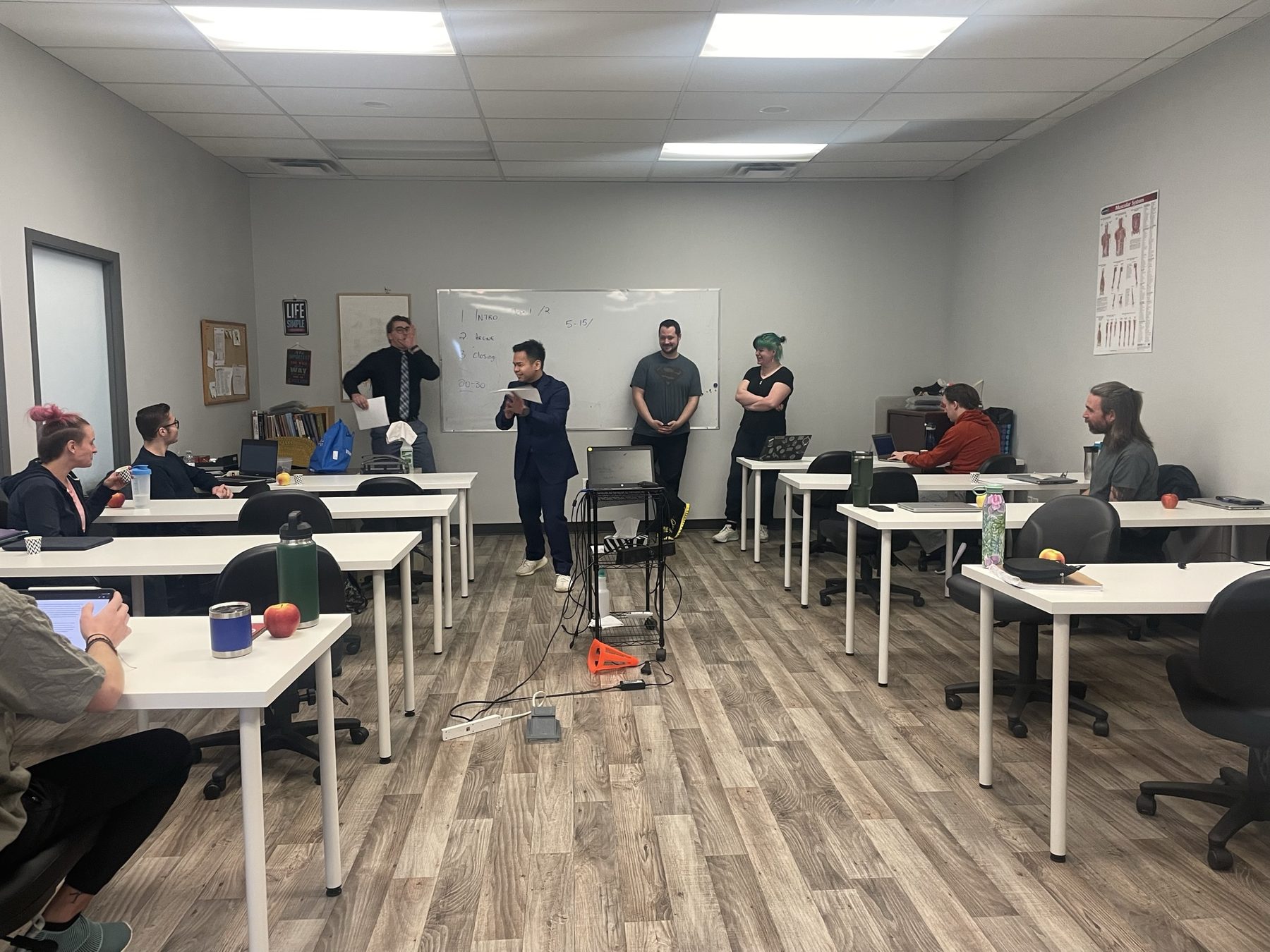
Massage Therapy students working on clients at treatment tables in the Axiom lab
Diploma · 2,200 hours · Blended

Two years from now, the hands people trust are yours.

Registered as “Medical Massage Therapy”

A 2,200-hour diploma preparing you for the massage therapy entry-to-practice exam pathway — and to run your own practice.

$40,800 / yr median in Saskatchewan
Massage therapists — Government of Canada Job Bank, Nov 2025
Blended
Mode of delivery
2 years
2,200 hours total
December 2026
Next intake · starts December 4, 2026

Overview

Train for the actual job.

The practice of massage is universal, with many referrals from health care professionals for its physical, mental, and emotional benefits. Massage therapy is an evolving field—diverse and filled with opportunity. Axiom's Medical Massage Therapy program is current, evidence-based, and aligned with the latest research. We approach massage education with innovative ideas that appeal to a variety of learners, combining academics, hands-on training, and practicum experiences.

Read the full overview

Students engage in lectures, labs, class discussions, workshops, outreach missions, and on-demand online classes that provide flexibility and support; this blended learning model allows students to balance their studies with personal commitments. Highlights include cadaver labs with the University of Saskatchewan biology department and anatomy labs where students literally build the body from the inside out.

In our experience across the last ten years, the majority of graduates have secured employment or clinic placements before graduation — most RMTs go on to self-employed practice.

This two-year, 2,200-hour diploma prepares you for board exams and a career in massage therapy. The program is challenging, but we are committed to helping you reach your goals and full potential. At Axiom, we foster a supportive learning environment that is fun, positive, and inspiring.
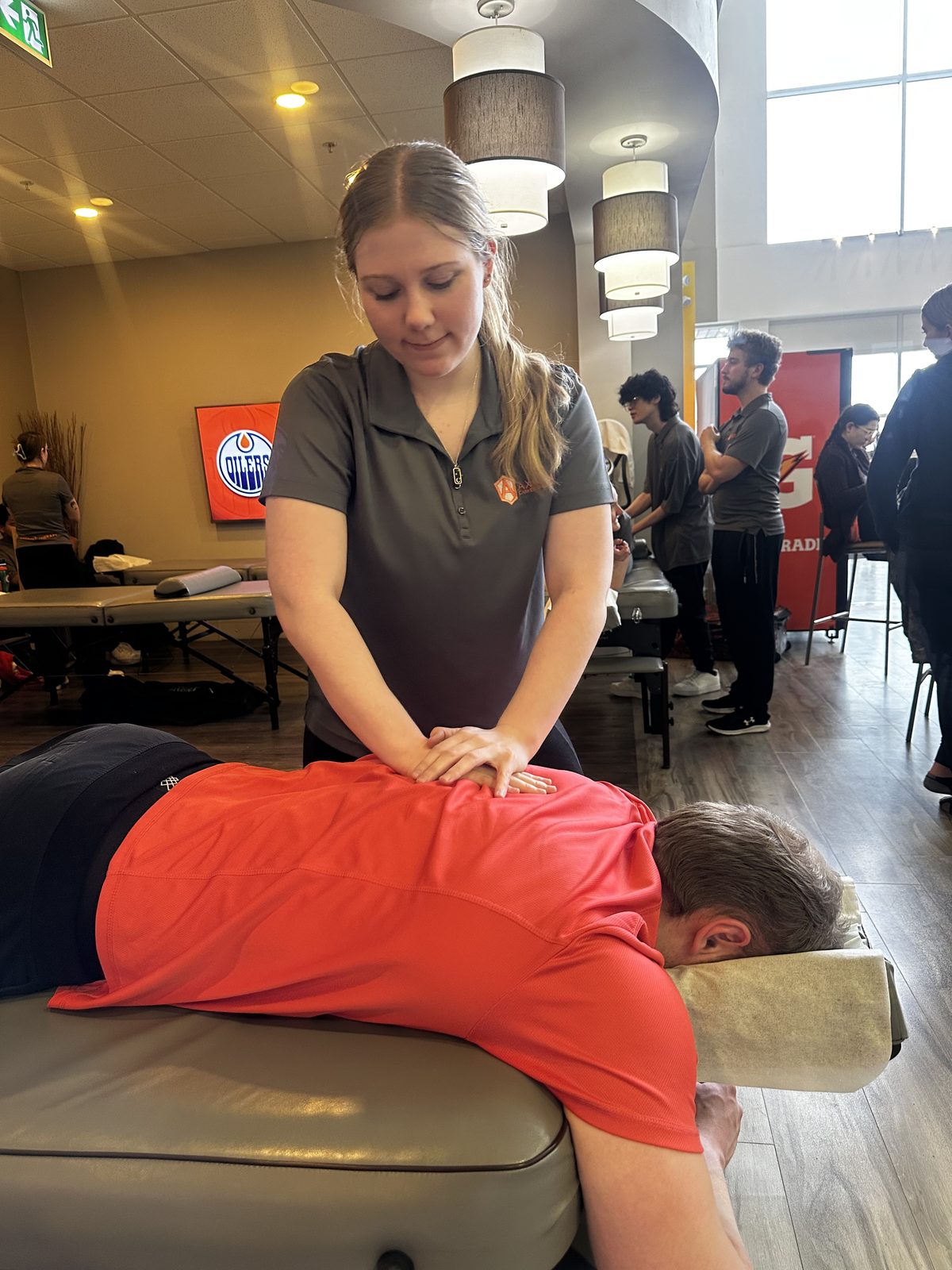
Massage Therapy students working on clients at treatment tables in the Axiom lab

Career paths

Where this diploma takes you.

Saskatchewan pay
$40,800 / yr median in Saskatchewan
Massage therapists · NOC 32201
Government of Canada Job Bank, Nov 2025
Where graduates work
  • Self-employed practice (most common)
  • Group and team clinics
  • Private practice
  • Hospitals
  • Rehabilitation centres
  • Extended care
  • Educational institutions
Why this program holds up
✓Supports the Canadian Inter-Jurisdictional Practice Competencies for Massage Therapists at Entry-to-Practice.
✓Accreditation for the Massage Therapy program is in progress.
✓Exams and major assignments are scheduled around breaks to protect mental health.
✓Instructors act as facilitators, not lecturers.
✓The Business course: Axiom positions itself as the only massage college that teaches you to be an entrepreneur, not just a therapist.

Massage therapy is not currently a legislated (regulated) profession in Saskatchewan — the Saskatchewan College of Massage Therapy is expected to form in the next few years. Axiom's program is built to support the Canadian Inter-Jurisdictional Practice Competencies; the “RMT” designation is held through membership in a professional association, not a provincial licence.

Most RMTs are self-employed, commonly renting a treatment room as a sole proprietor — so income scales with the practice you build. Clinic rates in Saskatoon average $100–$115 for a 60-minute massage (per the college, 2026).

The college's own earnings estimate, from ten years of graduates: practising RMTs typically make $65,000–$100,000 a year — roughly $40,000–60,000 in your first year while you build a practice, and $75,000–100,000 by your third (college estimate, 2026).

The Government of Canada Job Bank rates the Saskatchewan employment outlook for massage therapists as Good (3-year outlook, 2025–2027).

What you'll be able to do

By graduation, with nobody looking over your shoulder.

01
Assess and treat

Orthopedic assessment, remedial exercise, and treatment planning for real presenting conditions.

02
Work across modalities

Swedish massage through prenatal care — graduates finish Prenatal Level A certified — plus infant, paediatric and geriatric care, with workshops in Thai massage, Shiatsu, myofascial release and sports massage.

03
Run the business

The only massage college here that teaches you to be an entrepreneur, not only a therapist.

2,200
hours of instruction and practice
Format
Blended. Year 1: 3 days in-person / 2 days online per week. Year 2: 2 days in-person / 3 days online per week.
Practicum
Practicum runs through both years. As part of it you work one shift per week in the on-site Student Massage Clinic, under clinical supervisors with a minimum of three years in practice (many with over ten). You gain experience as a practitioner, receptionist, and entrepreneur, using online booking, electronic medical records, progress reports, and patient feedback.
Exams, clinic practice, and what graduation requires

Graduates hold the “RMT” designation through membership in a professional association such as MTAS or NHPC. No Saskatchewan association currently runs a board exam — the MTAS MQE was discontinued in spring 2026, ahead of the expected formation of the Saskatchewan College of Massage Therapy — and the program is built to support the Canadian Inter-Jurisdictional Practice Competencies so graduates are ready when regulation arrives.

Deliver supervised massage treatments to the public through the student clinic: obtain consent, complete subjective and objective assessment, treat, provide homecare, chart in an EMR using SOAP notes, and maintain sanitisation standards.

Run the business side of a practice — the Business course is part of the diploma.

Specialized training includes 14
Cancer careDeep tissueDisabilities & special needsGeriatric massageHospice & end-of-life careHospital & surgery supportInfant & pediatric massageManual Lymphatic Drainage (MLD)Muscle Energy Techniques (MET)Myofascial Release (MFR)Prenatal (Level A)ShiatsuSports & athleticsThai massage
What's included 7
Anatomy, physiology, kinesiology, pathologyOrthopedic assessmentMassage techniques and treatment planningEthicsSupervised clinic practiceBusiness and entrepreneurship trainingMentorship and professional communication

Courses

What you'll study.

2 years, 4 terms plus a continuous practicum — open any course for its full description.

Year 12 terms + practicum · 16 courses
Continuous through Year 12 courses
Practicum
Including Administration & Massage services. Students will gain hands-on practical work experience under professional and qualified supervisors, and instructors. Skills that they learn in class will be transferred and applied in a real work setting to people who seek their help and expertise. Students will deliver patient informed consent; they will practice how to ask for subjective information before assessment and treatment. Practicum will include subjective and objective assessments, treatment, and homecare including remedial exercise recommendations. Documentation using electronic medical records with a SOAP note format. Room and laundry sanitization practices
Administration
Administration is the hands-on experience required as practical office experience. The hours will be obtained through the on-site Student Massage Clinic with a qualified supervisor.
Term 17 courses
CPR (Level C with AED)
This CPR course will certify the student in level C with defibrillator use. This is the level of CPR/first aid that is required for Practicing Massage Therapists to be elgiable for Malpractice Insurance. A certified CPR instructor will teach this course at an on location.
Ethics & Professionalism
This class is about the ethics and guidelines that Massage Therapists must practice. The unique nature of the industry requires that interns have a solid understanding of ethical foundations, boundaries, professional relationships, and how to communicate with patients and colleagues. This course guides you through self-assessment, how to establish and maintain boundaries, ethical scenarios, conflict, and resolutions.
Gross Anatomy 101
This class is designed to focus on the concepts and principles of gross anatomy, palpatory anatomy, and kinesiology. The purpose of this class is to emphasize the development of skilled palpation as a fundamental component of effective manual therapy techniques. A solid knowledge base and understanding of how muscles and joints interact based on their structure and function create a Functional Skills Model. This model helps ingrain the accurate location of various anatomical structures through kinesthetic experience, quality of touch, and effective patient communication. The class incorporates a unique, experiential, and participatory environment where students can retain information while learning to use critical and creative thinking processes. Additionally, students will palpate and massage the targeted muscles, aiding in a better understanding of the designated muscle’s location, size, texture, role in posture, and dynamic movement.
Medical Terminology
Basic and advanced medical terminology courses will give the student an understanding of the medical language. Units will be body system specific. Included in this course are prefixes, suffix, and word root usage, pronunciation, and terminology with definitions of medical words. Students will have relevant and specialty-specific knowledge of medical terminology. The modules contained in this class are a foundation for the program and career.
Massage Theory & Practical 101
MTP 101 is an introductory to Massage Theory and Practical for entry-level Massage Therapists. This class will introduce the philosophy of massage, its origins, and its development through history. Students learn the foundations of human biology, the body's soft tissue, and how to apply appropriate massage. They will understand health, optimal function, injury, dysfunction, and tissue repair, and how massage can affect the body. General conditions will be introduced in this class. Students will learn appropriate techniques, therapist biomechanics, and postural skills, draping contraindications, basic assessments, electromagnetic paradigm, neurological goals, functional goals, mental health implications, SOAP charting, public health, and treatment goals.
Orthopedic Assessment 101
This class introduces physical and medical assessments for the entry-level massage therapist. Students will learn about patient histories, observation, and ROM, and how to document them to SOAP notes. Students will know examination principles; vital signs, scanning examination, joint examination, functional assessment, introduction to orthopedic testing, reflexes and cutaneous distributions, joint play movements, and palpation. An introduction to medical imaging is also addressed. Specific areas of the body that review anatomy, understand patient history, observation, and examination skills are the head, face, cervical spine, thoracic spine, and lumbar spine (Axial skeleton). The cervical spine will be generalized in this introductory class and explored in more detail in OA 200 during whiplash and nerve lesions to coincide with MTP 200 class.
Physiology 101
This class is an introduction to physiology, focusing on basic physiological fundamentals of the human body. Students will understand how the body is organized from chemical, cellular, and tissue levels, establishing the building blocks for the entire body. The major tissues of the body such as skin, bone, muscular, and nervous are taught in detail. Students will have the firm knowledge necessary to continue to Physiology 115.
Term 27 courses
Gross Anatomy 120
GA 120 is a continuation of GA 101. This class further builds the Gross Anatomy foundations that continue onto the appendicular skeleton including the shoulder girdle, pelvis, upper and lower extremities. Students will have a comprehensive knowledge of the boney landmark and skeletal muscular anatomy.
Massage Theory & Practical 120
MTP 120 continues from MTP 101, further building on general systemic conditions and introducing students to specific conditions that massage can treat and influence. Circulatory, systemic, neural compression and overuse conditions and the state of pregnancy are comprehended. For each condition, student skills include observation, palpation, CI, modifications, testing, treatment plans and goals, specific treatments and techniques, self-care plans and goals, and expected outcomes.
Nutrition 101
This is an introduction to nutrition. Included in this class are the components of nutrients, how they are obtained, what they are used for, and how our body cleanses. Food groups and healthy eating is discussed as a base for self-care. Emotional eating, anxiety, depression, immunity, and inflammation are examined, and how nutrition can influence the body’s functions and ability to heal.
Orthopedic Assessment 120
This class is a continuation of OA 101. It has specific orthopedic testing that coincides with MTP 120. Students will know anatomy, patient history, observation and examination principles, scanning examination, joint examination, functional assessment, special (diagnostic) testing, reflexes and cutaneous distributions, joint play movements, palpation, medical imaging, and case studies (where applicable). Students will know how to assess gait, lumbar spine, pelvis, and shoulder.
Physiology 115
This class requires PHYS 101 as a prerequisite. Physiology 115 is a detailed learning experience of the human body systems and their corresponding anatomy. All body systems are included in this class; cardiovascular, lymphatic, respiratory, endocrine, digestive, urinary, reproductive, development, inheritance, and the special senses.
Remedial Exercise 101
This class is an introduction to remedial exercise. Students will learn about mobility, strength and power, balance, functional progression in therapeutic exercise, and unique applications of therapeutic exercise.
Pathology
Pathologies in the context of massage therapy are discussed, with an emphasis on critical thinking and practical application of concepts. A Massage Therapist will be able to make safe, effective, evidence-informed choices about massage therapy for their patients who live with challenges to their health.
Year 22 terms + practicum · 14 courses
Continuous through Year 21 courses
Practicum
Including Administration & Massage services. Students will gain hands-on practical work experience under professional and qualified supervisors, and instructors. Skills that they learn in class will be transferred and applied in a real work setting to people who seek their help and expertise. Students will deliver patient informed consent; they will practice how to ask for subjective information before assessment and treatment. Practicum will include subjective and objective assessments, treatment, and homecare including remedial exercise recommendations. Documentation using electronic medical records with a SOAP note format. Room and laundry sanitization practices
Term 37 courses
Gross Anatomy 200
GA 200 is an advanced second-year program that reviews content from GA 101 and GA 120. The focus of this class is joints and neurovascular components. Specifically synovial joints, ligaments, and their bony attachments; terminal nerves, pathways, and vascular paths of the entire body.
Hydrotherapy 101
Hydrotherapy will connect massage therapists to the concepts of body and water. Water is the most abundant substance in the human body and has a major influence on its functions. This class focus will be more on body and wellness using hydrotherapy to aid in obtaining patient goals. Explore the in-depth information on concepts and the hands-on practical applications. This class will enhance Medical Massage Therapist practice.
Kinesiology
This course is designed to serve as an introduction to the study of kinesiology. This process will be accomplished by starting with the key structures in the body that are essential for movement. Biomechanical principles such as statics and dynamics, force, inertia, torque, vectors, friction, velocity, and momentum, along with the laws of motion, will be explored. With the human body framework and knowledge of physical laws and concepts presented, students will delve into the complex aspects of posture, gait, and movement. Analysis of movement is important for massage therapists to identify the source of musculoskeletal dysfunction, and to create appropriate treatment plans aligned with pertinent goals to achieve the best outcomes. Students will understand the value of healthy biomechanics, analyze movement, and exercise, and appreciate physical laws within kinetic analysis.
Massage Theory & Practical 200
MTP 200 is a second-year course that continues from MTP 120, further building on specific conditions that massage can treat and influence. Students will understand conditions of the central nervous system, gastrointestinal concerns, motor vehicle accidents, sports injuries, and sports massage; workshops to be included where applicable. For each condition, student skills include observation, palpation, CI, modifications, testing, treatment plans and goals, specific treatments and techniques, self-care plans and goals, and expected outcomes. Workshops and out-reaches will further refine students’ practical skills.
Neuroanatomy
This course focuses on the physiology and anatomy of the nerves, brain, and spinal cord. The nervous system is a unique and complicated entity that controls everything in the human body. Nerve functions, names, and paths will be taught in detail for the entry-level massage therapist to apply to their career confidently.
Orthopedic Assessment 200
This class is a continuation of OA 120. It has specific orthopedic testing that coincides with MTP 200. Students will know anatomy, patient history, observation, and examination principles, scanning examination, joint examination, functional assessment, special (diagnostic) testing, reflexes and cutaneous distributions, joint play movements, palpation, medical imaging, and case studies (where applicable). Students will know how to assess neurological pathologies (CNS & PNS), nerve compression injuries, and knee and sports emergencies.
Pharmacology 101
Pharmacology 101 is designed to equip massage therapy students with essential knowledge and understanding of drugs, medications, and topical agents relevant to their practice. The curriculum focuses on medications and pain management, understanding and assessing medications, recognizing contraindications and precautions, integrating pharmacological and massage therapy approaches, and considering ethical implications. This course aims to prepare massage therapy students to be empowered practitioners who can provide comprehensive care, ensure safety in practice, and foster collaborative partnerships with other healthcare providers for improved client outcomes and overall well-being within the massage therapy scope of practice.
Term 46 courses
Business
This business course is designed to enhance a massage therapist's theoretical and practical business skills that are vital to every entrepreneur. The relevant material will make graduates confident when managing their businesses. Subjects include (but are not limited to), technology, documentation, storing records, written communication, start-up, marketing, costs, insurance and benefits, direct billing, taxes, bookkeeping, excel, financial literacy, banking and finances, employment, self-employed structures, resumes, and contracts. Axiom is the only Massage College that teaches you how to be an entrepreneur, in addition to being a Massage Therapist.
Gross Anatomy 250
GA 250 is an advanced second-year class that ties all the information together from GA 101, GA 120, GA 200, NA 101, and KIN 101 information will be all combined and reviewed for students to understand the bigger picture of human gross anatomy. Origin, Insertion, Action, and Nerve innervation will be the focus of this class. Highlighting palpation, treatment, and movement (action) of each muscle will enlighten students to further develop. As student’s critical thinking and problem-solving skills evolves, they are more confident in their practical applications.
Massage Theory & Practical 250
MTP 250 is an advanced course, building on specific conditions and techniques that massage can treat and influence. Students will learn about Conditions of the Peripheral Nervous System, Infant and Pediatric Massage, and Geriatrics; workshops to be included where applicable. Additional Workshops are included in this advanced class to provide an opportunity for hands-on development of techniques. Workshops include Shiatsu, Myofascial Release Massage, and Thia Massage. Students will also organize an ‘In-reach’ and participate in out-reaches. There will be a formal review of the entire body and techniques that students have covered in their two years of classes. For each condition, student skills include observation, palpation, CI, modifications, testing, treatment plans and goals, specific treatments and techniques, self-care plans and goals, and expected outcomes. The student will explore the concept of self-care for the working Massage Therapist and what health means to an individual. Health is explored for its mental, emotional, and body components. Different massage modalities are explored to introduce the many diverse paths that a Massage Therapist has to choose from. Other modalities (chiropractic, physiotherapy, acupuncture, naturopath, etc) are discussed for self-care and patient care, and how they are complementary to massage (vice versa).
Orthopedic Assessment 250
This class is a continuation of OA 200. It has specific orthopedic testing that coincides with MTP 250. Students will know anatomy, patient history, observation, and examination principles, scanning examination, joint examination, functional assessment, special (diagnostic) testing, reflexes and cutaneous distributions, joint play movements, palpation, medical imaging, and case studies (where applicable). Assessment protocol for severe musculoskeletal injuries will be reviewed including whiplash, dislocations, and Temporomandibular joint disorders. There will be a comprehensive review of OA 101, OA 120, OA 200, and OA 250 as students prepare for graduation and board examinations.
Remedial Exercise 120
This class is an advanced remedial exercise class. It covers basic concepts of dense connective tissue, wound healing, anthology, chronic pain management, myofascial considerations, and assessing musculoskeletal disorders. Soft tissue manipulations including joint play will be discussed and practiced. We will explore how massage therapists can approach conditions in different ways. The foundation of functional exercise will bridge into clinical applications for peripheral joints and the spine.
Research Methodology 101
Research Methodology 101 provides students with a comprehensive understanding of the historical development of massage therapy, research methods, evidence-based practice, and critical thinking skills. Students will explore the past and present research evidence on the effectiveness of various massage therapy techniques and modalities for different populations and conditions, learn to connect research findings with clinical practice, and discuss future directions in massage therapy research.

Cadaver labs are no longer a guaranteed part of the program. When offered through MTAS (Axiom students are MTAS student members), students have the option to join for $187.50 incl. GST.

Admission requirements

Ready to apply?

Pathway 01
Standard admission
✓Registration fee: $120 per year. Paying it secures your spot; all other requirements are due at your intake appointment.
✓Grade 12, or CAEC/GED/ABE — high school transcripts are waived when applying as a Life-Long Learner
✓Health Science 20 or Biology 30 (Life-Long Learners are exempt from this prerequisite)
✓Criminal record check with vulnerable sector check — obtained through your local RCMP or city police detachment
✓Physician's health form — obtained through your family physician, chiropractor, physiotherapist, naturopath, or nurse practitioner
✓Proof of English language proficiency — required for the program (see options below)
✓Basic computer literacy
Download the document checklist (PDF)
Pathway 02
Life-Long Learner

21 or older by the first day of class, and finished high school at least two years before classes start? Tick “Life-Long Learner” when you apply — transcripts waived, academic prerequisites exempted.

How the pathway works
Language requirements
English proficiency

Any one of the following:

✓Canadian high school diploma
✓Transcript that shows completion of English 30 or a Grade 12 English equivalent
✓Proof of completion of the General Educational Development (GED) test
✓Results from a recognized English language proficiency test that meet the required score
✓Duolingo English Test: score of 115 or higher

Tuition & fees

A clear cost, published in full.

Every dollar is on this page — tuition, books, fees and supplies. If it is not listed here, you do not pay it.

Year 1
~$16,143
all in, billed first
Registration fee $120
Tuition $12,000
Textbooks ~$879.25
Materials $90
Kit $2,318.90
Other fees $735
Year 2
$14,086
billed when Year 2 begins
Registration fee $120
Tuition $12,000
Textbooks $121.10
Student fees $1,845

Both years together: ~$30,229. Year 2 is not part of your first-year bill.

The fine print — what these figures include
Year 2 student fees include: Athletic tape, Clinical shirt, Hydrotherapy fee, Labs, Malpractice insurance, Outreach fee, Printing fee, Remex fee, Workshops.
Registration fee includes: Mandatory, non-refundable registration fee. Payable to Axiom..
Tuition includes: Mandatory fee covering Year 1 instruction, online learning, practical training, assessments, and supervised student clinic. Payable to Axiom..
Textbooks includes: Required textbooks purchased independently by students. New or used textbooks are accepted, provided they meet course requirements. Cost is estimated..
Materials includes: Mandatory course materials, consumable learning supplies, and printed educational resources. Payable to Axiom..
Kit includes: Mandatory clinical equipment, uniforms, and practical training supplies provided by Axiom..
Other fees includes: Mandatory malpractice insurance, CPR certification, examination software, educational workshops, and accreditation fees. Payable to Axiom..

All pricing subject to change. Registration fees are non-refundable.

Required textbooks are purchased independently by students and are the student's responsibility to obtain for the start date of each class; a textbook list is provided at your intake appointment. Prices are estimates including tax. New or used textbooks and e-books are accepted, provided they meet course requirements.

Student fees are paid at orientation if you are not applying for, or approved for, a student loan or grants. If you already hold a valid CPR certificate that is not up for renewal, the CPR amount is deducted from your total.

Financial aid & payment plans are available. Eligible for student loans · Interest-free payment plans available · Student loan application assistance available. How people actually pay for it →

Schedule

Will this fit your life?

Full-time (monthly starts)

Full-time is 10 months (43 weeks) per year for two years. Classes Monday to Friday, 9:00am–3:00pm, blended online and in-person, plus student clinic shifts in the evenings.

Morning classes · Mon–Fri 9:00am–11:45am
Lunch · Mon–Fri 11:45am–12:15pm
Afternoon classes · Mon–Fri 12:15pm–3:00pm
Student clinic Evenings; times vary
Part-time (monthly starts)

Part-time is 12 months (52 weeks) per year for two years. Two evenings per week, 3:30–7:30pm, plus a weekly clinical shift — roughly a 20-hour weekly commitment. Online courses are flexible, on-demand classes you fit into your week according to the weekly lesson plan.

Evening classes 3:30pm–7:30pm
Weekly clinical One clinical shift per week; times vary
Format
Blended. Year 1: 3 days in-person / 2 days online per week. Year 2: 2 days in-person / 3 days online per week.
Breaks: All statutory holidays · Two weeks at Christmas · One week in February · One week at Easter.

Year 1 is 3 days in-person and 2 days online each week; Year 2 is 2 days in-person and 3 days online.

Part-time classes run twice a week, plus one clinical shift per week (times vary).

Monthly start dates are ministry-approved for both the full-time and part-time tracks.

The class schedule is confirmed annually and issued as a Google Calendar within three months of the program start date.

Finals are scheduled before major breaks; exams and major assignments are scheduled around breaks to protect mental health.
Walk through a real day →

Next intake · December 4, 2026
Ten minutes to apply. Enrolment is first-come, first-served.

Or phone and ask anything first — nobody here works on commission.

Apply now (306) 952-0509
Monday–Friday: 9:00am – 4:00pm
CALL Apply now